
Smart packaging to reduce food waste
Oxygen sensors that check every MAP pack, from packing line to supermarket shelf
Senoptica prints a patented oxygen-sensing ink into the lidding film of modified atmosphere packaging (MAP). The oxygen level in every pack can be checked on the packing line and again anywhere in the supply chain without affecting pack integrity. Fewer failed packs reach the shelf, and less good food is thrown away.
Request information See how it works
- Less food waste
- 100% pack inspection
- Fewer customer complaints

Accept · oxygen within spec Reject · oxygen out of spec
Why do failed MAP packs reach the shelf and end up as waste?
MAP pack integrity is usually tested by destroying a small sample of packs. A pack that has lost its protective gas looks the same as a good one, so leaks go unnoticed until the food spoils early and is thrown away, in store or at home.
~2%
of modified atmosphere packs fail
1 in 100,000
chance of catching a failed pack with typical destructive sampling
100%
of packs are inspected with Senoptica without affecting pack integrity
How it works
How Senoptica’s oxygen sensors work
Printed sensors are read at every stage of the pack’s life, giving non-invasive, 100% inspection of modified atmosphere packaging.

01
Sensor printed into the lid
A patented oxygen-sensing ink is printed directly into the MAP lidding film. Nothing extra is added inside the pack.

02
Every pack scanned in-line
After sealing, an in-line scanner reads each pack and accepts or rejects it against the oxygen specification for that product.

03
Checked anywhere in the supply chain
Handheld readers can be used to check packs throughout the distribution chain, at goods-in in supermarkets, and during daily stock rotation in store.

04
Results in one data platform
Every reading feeds the Senoptica data platform, showing pack performance from line to shelf and flagging packs at risk of early spoilage.
Food waste reduction
Reducing food waste
Every failed pack that reaches the shelf is food that will be thrown away, along with the energy, water, and packaging that went into it. Senoptica helps prevent that waste at every stage, from the factory to the store.
1/3
of all food produced globally is lost or wasted
29bn
a year lost by global retailers to failed packs
At the factory
Stop failed packs at source
Leaking packs are caught on the packing line, so they never travel through the supply chain only to be binned later.
In the supply chain
Find problems early
Packs damaged in transit are found at goods-in, before they take up shelf space and spoil.
In store
Sell food while it’s good
Targeted price-downs move at-risk packs while they are still good to eat, rather than throwing them away at end of life.
In reporting
Evidence for waste targets
Pack-level data supports reporting against food-waste commitments such as the EU 2030 targets and the UK Food and Waste Pact.

Who it’s for
MAP pack inspection for retailers, food producers, and packaging suppliers

Retailers
Cut chilled food waste, meet your waste-reduction targets, and sell more of what reaches the shelf.
- Reduce food waste by finding failed packs before they spoil on the shelf
- Target price-downs so at-risk packs sell while still good to eat
- Report measurable progress against food-waste and ESG commitments
- Spot-check deliveries at goods-in and every pack at stock rotation
- Fewer customer complaints about food spoiling early at home
Food producers and processors
Inspect 100% of MAP packs on the line without destroying any, cut waste from failed packs, and enhance line performance with real-time data.
Packaging and lidding film suppliers
Offer a smart lidding film that helps food producers and retailers reduce waste, giving them a measurable reason to choose it.
Senoptica Technologies is a Trinity College Dublin spin-out developing oxygen sensors, scanners, and a data platform for modified atmosphere packaging, helping the food industry reduce waste.
Working with
- US FDA clearance 2024
- EIT Tech Validation Award Winner 2024
- Business Post Hot 100 Start-ups 2024
- Automate UK Awards Shortlisted 2026
- CIRCULÉIRE Venture Awards Shortlisted 2026
FAQs
Oxygen sensing in MAP and food waste, answered
What is modified atmosphere packaging (MAP)?
Modified atmosphere packaging replaces the air inside a food pack with a controlled mix of gases, usually oxygen, carbon dioxide, and nitrogen, to slow spoilage and extend shelf life. It is widely used for fresh meat, poultry, fish, cheese, and ready meals.
How does Senoptica help reduce food waste?
A leaking MAP pack spoils early and is usually thrown away. By checking every pack, Senoptica helps producers stop failed packs at source, helps retailers find them at goods-in and in store, and lets at-risk packs be priced down and sold while still good to eat.
How does Senoptica measure oxygen in a MAP pack?
An oxygen-sensing ink printed into the lidding film responds to the oxygen level inside the pack. A scanner reads the sensor through the lid, so a pack whose oxygen level is outside its specification, for example because of a leaking seal, can be identified and rejected without opening it.
Do packs have to be opened or destroyed to test them?
No. Testing is non-invasive, so every pack can be checked and still sold. This replaces destructive sampling, where a small number of packs are tested and then discarded.
Can packs be checked after they leave the factory?
Yes. Because the sensor is part of the pack, handheld readers can check it at depot goods-in, in store during stock rotation, or at any other point in the supply chain.
Latest news
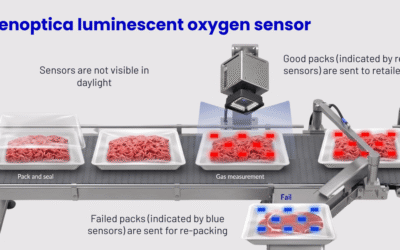
Video – How Senoptica’s Oxygen Sensor Technology Works
Most MAP (modified atmosphere packaging) packs are checked by pulling a small sample off the line and testing the packs in that sample destructively. In this video, Senoptica CTO Steve Comby explains how our printed oxygen sensor makes it possible to check every pack....
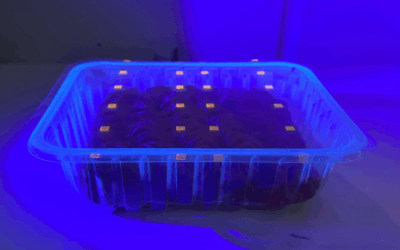
Video – Senoptica’s Oxygen Sensor Technology
In this video, CTO Steve Comby explains Senoptica's oxygen sensor technology including what it is, how it works, how the sensors are applied to food packaging, and how the sensors are read. Steve also explains the importance of measuring oxygen in MAP packaging, how...
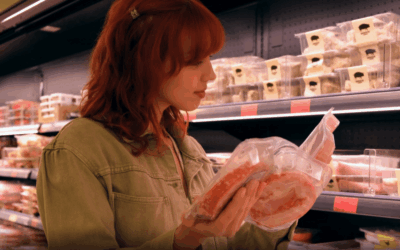
Video: From Spot Checks to 100% Inspection
Quality checks on packaged food have long relied on sampling. In this video, Senoptica CEO Seamus Farrell explains how new technologies now make it possible for manufacturers to move to real-time, pack-level inspection of every pack that leaves the line. It's a shift...
Request information
Find out how oxygen sensing could reduce waste across your packs, your line, or your stores. Tell us a little about your business and the team will be in touch.